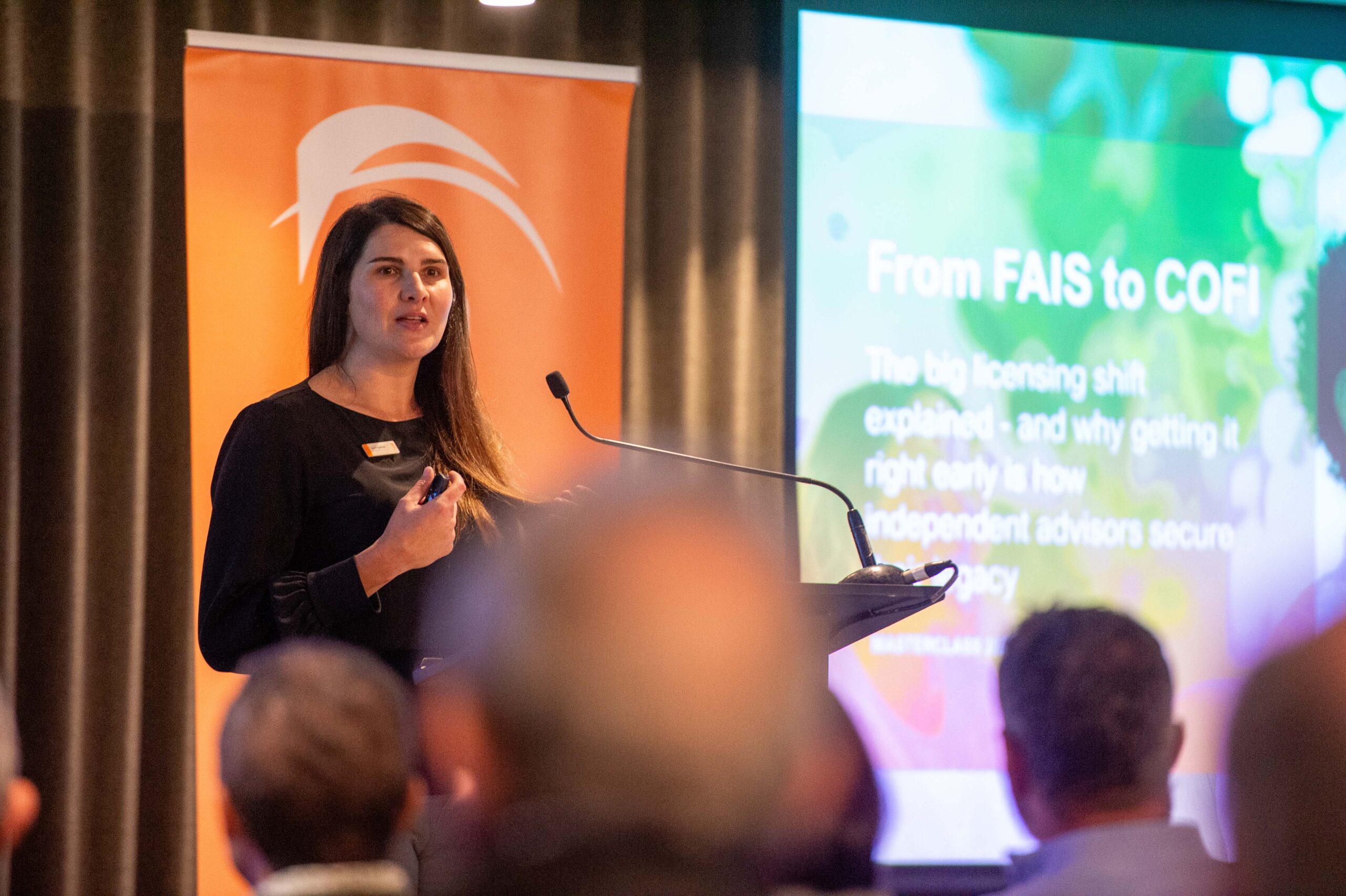
For many financial advisers, the word COFI is increasingly difficult to ignore. As the Conduct of Financial Institutions framework moves closer to becoming a reality, uncertainty about licensing, business structures and future requirements is beginning to give way to a more pressing question: Is my business ready?
According to Anri Dippenaar, Head of Compliance at Masthead, speaking at the recent Masthead Masterclass, the answer starts with understanding what a business does, rather than simply relying on its existing FAIS licence or traditional industry label. “The shift is not what you are, but effectively what you do,” she explains. That change in thinking is at the heart of COFI readiness and could require advisers to look at their businesses through a different lens.
Moving beyond the FAIS label
Under the current framework, advisers often describe themselves according to their licence category or the products they advise on. An advice-led practice might identify itself as a Category 1 FSP, for example, with the products it offers helping to define its place in the market. COFI introduces a far more activity-based approach.
Instead of simply asking what type of FSP a business is, firms will need to identify the activities they perform, from providing advice and servicing clients to sales, execution, aggregation and comparison. “The question we need to answer is, what do you do in your business?” says Dippenaar.
This distinction matters because two businesses with identical FAIS licences may have very different activities and therefore different obligations under COFI. For small and independent practices, this should not automatically be interpreted as a threat to independence or a requirement to merge with a larger business. Instead, Dippenaar says, proportionality will be important. “Independence is not the problem. Your small business structure is not the problem. Clarity really is the problem.”
Preparation starts with understanding the business
One of the biggest risks for advisers is treating COFI as a simple relabelling exercise. A direct conversion from a FAIS licence to a COFI licence could overlook activities that are already taking place within the business. A practice may consider itself primarily an advice business, for example, but its day-to-day operations could also involve sales and execution, administration, servicing or other activities that need to be identified.
Dippenaar recommends that advisers start by mapping the entire client journey. “Go back to your office, unpack your client journey, unpack everything you do in your business,” she says. “Look at your leads, look at your advice channel, look at your marketing, look at your sales, look at your servicing, look at how you execute in your business.” The objective is not to restructure the business immediately, but to understand it properly.
This is particularly important while COFI remains in draft form. Firms cannot make definitive licensing decisions based on requirements that may still change. What they can do is use the time available to understand their businesses and prepare for the eventual transition.
Documentation will be critical
Preparation also means creating an evidence trail. Dippenaar highlights weak documentation as one of the biggest challenges in compliance. Advisers may be doing the right things, but if those decisions and processes are not documented, demonstrating compliance later can become difficult. This has implications beyond COFI. A well-documented business is easier to manage, protect, value and ultimately sell. “Think through, document, understand your business, make the right decisions,” she says. For advisers, this means reviewing business plans, succession plans, servicing structures, client journeys and operational processes. It also means recording why particular activities are or are not regarded as requiring licensing.
Don’t let the noise drive the strategy
With COFI generating increasing discussion across the industry, advisers may be tempted to make decisions before the final requirements are known. Dippenaar’s advice is to resist knee-jerk reactions. There is considerable speculation about what COFI will mean for smaller practices, technology requirements and licensing. But not all the information circulating in the market is accurate or relevant to every business. “Don’t listen to all the things you’re hearing in the industry. There is quite a bit of noise,” she says.
Instead, advisers should stay close to their compliance officers and use the available preparation time wisely. Masthead has also been engaging with regulators and gathering information from its adviser network to identify areas where greater clarity or education may be needed.
A strategic opportunity
Ultimately, COFI readiness should not be viewed purely as a compliance exercise. Understanding the activities, structure and operating model of a business can also provide an opportunity to strengthen the practice. For smaller firms in particular, the process could help clarify what they do, how they create value and whether their current operating model is sustainable. “It isn’t about giving up your independence. It isn’t about becoming a large business,” says Dippenaar. “It is about making sure you have a strong operating model story, something you can explain, and it will protect you into this next phase of the industry change.” For advisers, the immediate task is therefore relatively simple: understand the business before trying to understand the licence.
COFI may change the regulatory framework, but the firms that take the time now to understand their activities, document their processes, and build a clear operating model will be better positioned when the requirements finally arrive.
Subscribe to our free newsletter
Stay at the forefront of financial advisory excellence with MoneyMarketing's weekly insights. As a professional adviser, you'll receive carefully curated content that enhances your practice and client relationships without cluttering your inbox. Our commitment to delivering only relevant, actionable intelligence helps you make informed decisions that drive your business forward. Join our community of leading financial professionals today and transform your practice with our complimentary newsletter—because your success is our priority.