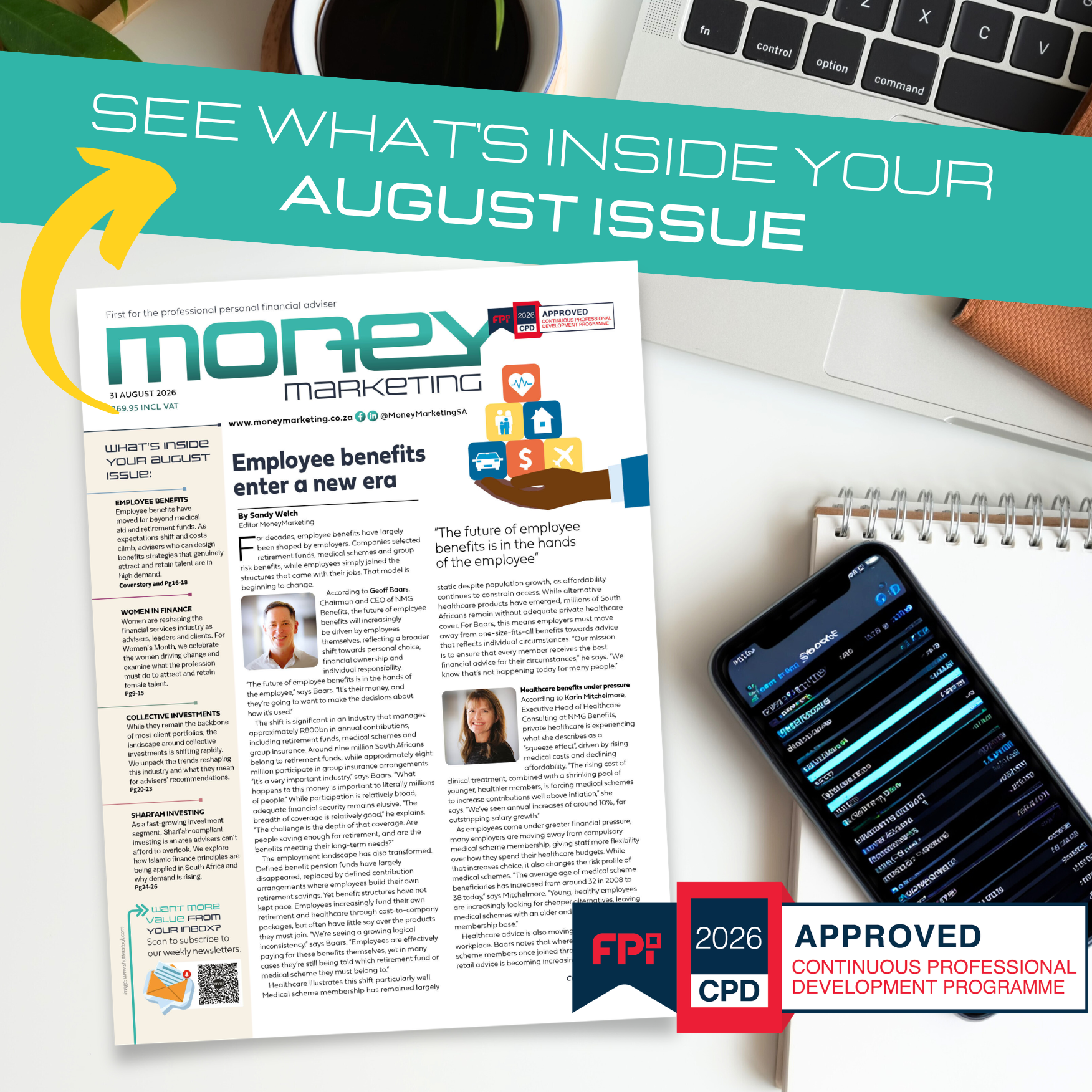
For decades, employee benefits have largely been shaped by employers. Companies selected retirement funds, medical schemes and group risk benefits, while employees simply joined the structures that came with their jobs. That model is beginning to change.
According to Geoff Baars, Chairman and CEO of NMG Benefits, the future of employee benefits will increasingly be driven by employees themselves, reflecting a broader shift towards personal choice, financial ownership and individual responsibility. “The future of employee benefits is in the hands of the employee,” says Baars. “It’s their money, and they’re going to want to make the decisions about how it’s used.”

The shift is significant in an industry that manages approximately R800bn in annual contributions, including retirement funds, medical schemes and group insurance. Around nine million South Africans belong to retirement funds, while approximately eight million participate in group insurance arrangements. “It’s a very important industry,” says Baars. “What happens to this money is important to literally millions of people.” While participation is relatively broad, adequate financial security remains elusive. “The breadth of coverage is relatively good,” he explains. “The challenge is the depth of that coverage. Are people saving enough for retirement, and are the benefits meeting their long-term needs?”
The employment landscape has also transformed. Defined benefit pension funds have largely disappeared, replaced by defined contribution arrangements where employees build their own retirement savings. Yet benefit structures have not kept pace. Employees increasingly fund their own retirement and healthcare through cost-to-company packages, but often have little say over the products they must join. “We’re seeing a growing logical inconsistency,” says Baars. “Employees are effectively paying for these benefits themselves, yet in many cases they’re still being told which retirement fund or medical scheme they must belong to.”
Healthcare illustrates this shift particularly well. Medical scheme membership has remained largely static despite population growth, as affordability continues to constrain access. While alternative healthcare products have emerged, millions of South Africans remain without adequate private healthcare cover. For Baars, this means employers must move away from one-size-fits-all benefits towards advice that reflects individual circumstances. “Our mission is to ensure that every member receives the best financial advice for their circumstances,” he says. “We know that’s not happening today for many people.”
Healthcare benefits under pressure
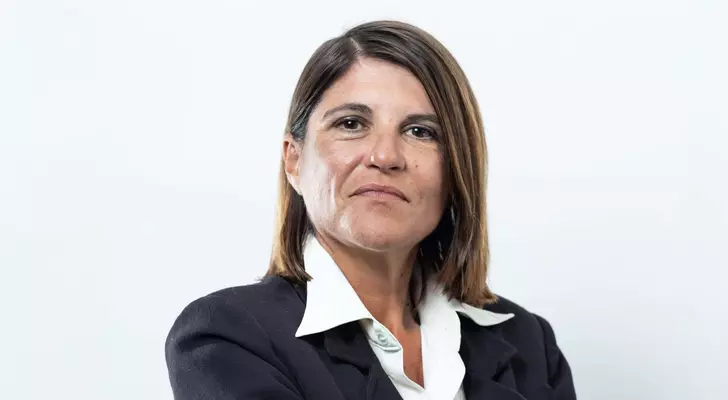
According to Karin Mitchelmore, Executive Head of Healthcare Consulting at NMG Benefits, private healthcare is experiencing what she describes as a “squeeze effect”, driven by rising medical costs and declining affordability. “The rising cost of clinical treatment, combined with a shrinking pool of younger, healthier members, is forcing medical schemes to increase contributions well above inflation,” she says. “We’ve seen annual increases of around 10%, far outstripping salary growth.”

As employees come under greater financial pressure, many employers are moving away from compulsory medical scheme membership, giving staff more flexibility over how they spend their healthcare budgets. While that increases choice, it also changes the risk profile of medical schemes. “The average age of medical scheme beneficiaries has increased from around 32 in 2008 to 38 today,” says Mitchelmore. “Young, healthy employees are increasingly looking for cheaper alternatives, leaving medical schemes with an older and more expensive membership base.”
Healthcare advice is also moving beyond the workplace. Baars notes that whereas most medical scheme members once joined through their employers, retail advice is becoming increasingly important. nvestments, life insurance and short-term insurance are also expected to become experts in medical schemes. That’s asking a great deal,” he says.
For Mitchelmore, this makes quality advice indispensable. “There isn’t a one-size-fits-all solution,” she says. “Every family has different healthcare needs, financial pressures and priorities.” She warns against selecting cover on price alone. “If people only compare monthly contributions, they can easily choose a plan that doesn’t meet their healthcare needs and ultimately costs them far more.” Instead, advisers should conduct thorough needs analyses that consider family circumstances, medical history and future healthcare requirements.
Mitchelmore also believes complementary products such as gap cover remain underutilised. “Only around 30% of medical scheme members have gap cover, when it should probably be closer to 50%,” she says. “Many people assume that because their medical scheme pays at 100%, everything will be covered. Unfortunately, that’s often not the case.” Most importantly, she believes advisers should build ongoing relationships rather than simply recommend products. “Healthcare needs change throughout people’s lives,” she says. “Good advice means helping clients make the next decision as their circumstances change.”
Retirement remains the biggest challenge
While healthcare affordability is under pressure, retirement funding remains South Africa’s greatest long-term employee benefits challenge. “We’re asking people who are already struggling to meet today’s expenses to save for a future that feels decades away,” says Trevor Kingsley-Wilkins, Head of Retirement Fund Consulting at NMG Benefits. NMG’s analysis shows the average employee is on track to replace only 30% to 38% of pre-retirement income, well below the commonly accepted target of around 75%. “Only about 6% of South Africans are expected to retire with an income that broadly matches their pre-retirement lifestyle,” he says.

The reasons are familiar: people start saving too late, contribute too little, and frequently cash out retirement savings when changing jobs. “Starting to save at 35 instead of 25 makes a massive difference,” he says. “Meaningful retirement outcomes require meaningful contributions.”
Kingsley-Wilkins believes the introduction of the two-pot retirement system marks one of the most significant reforms in decades. Before September 2024, between 70% and 90% of employees withdrew their full retirement savings whenever they changed jobs. “Every time someone cashed out, they effectively pressed the reset button on their retirement,” he says. “The compulsory preservation built into the two-pot system is one of the most positive developments we’ve seen.”
Investment performance and fees also matter. “If your investments aren’t beating inflation, you’re effectively becoming poorer,” he says. At the same time, he cautions employers and trustees against focusing only on headline administration fees. “There is no such thing as a free lunch,” he says. “An additional 1% in annual fees can reduce retirement outcomes by between 20% and 40% over a working lifetime.”
For Kingsley-Wilkins, improving retirement outcomes depends as much on education as product design. “When people understand the long-term impact of starting early, preserving savings and managing costs, they’re far more likely to make decisions that lead to financial security.”
Engagement is the future
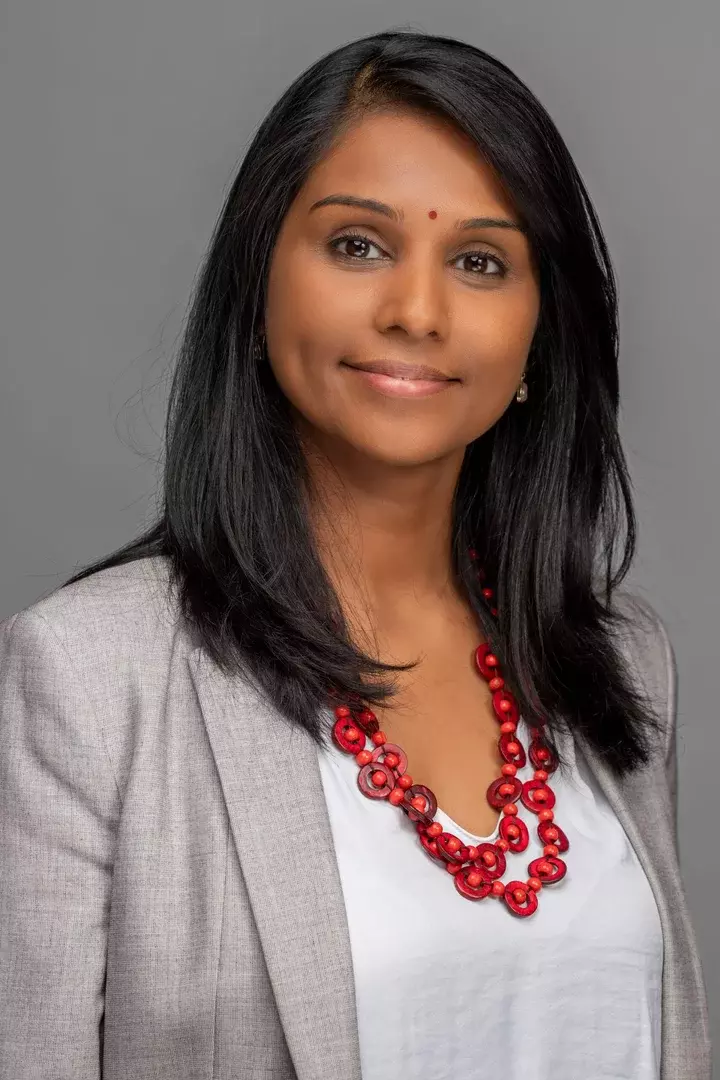
Lettesha Pillay, Head of Sales and Business Development at NMG Benefits, says meaningful engagement starts by acknowledging employees’ immediate financial realities. “The crisis is real,” she says. “People are using long-term savings to meet short-term needs. We see it in two-pot withdrawals, rising gambling, and growing reliance on informal lenders.” Financial stress inevitably spills into the workplace, affecting productivity, decision-making and morale.
“It’s no longer a personal problem,” Pillay says. “It becomes an employer problem because it directly affects the workplace and ultimately the bottom line.” This leaves employers with a difficult balancing act. They want employees to save for the future, while many workers are focused on making it through the current month.
Baars acknowledges the dilemma. “We don’t like telling people how to spend their money,” he says. “But we’re deeply concerned about the choices people are making.” He points to employees accepting lower gross salaries elsewhere simply because they are not required to contribute to retirement funds or medical schemes.
Rather than becoming less involved, employers need to shift from directing decisions to supporting better ones. “The employer’s role doesn’t disappear, it changes,” says Siphamandla Buthelezi, COO and Executive Head of Platforms. “Instead of simply deciding on behalf of employees, employers should ensure people understand the consequences of the financial decisions they make.”
The two-pot system has demonstrated that members are willing to engage digitally with their retirement savings, creating an opportunity for continuous education and personalised guidance. “The future of employee benefits is member-centred,” says Buthelezi. “For too long, the industry focused on employers and trustees. We now need to build systems with the member at the centre.” Mitchelmore believes healthcare is moving in the same direction, with employers increasingly seeking integrated solutions that combine healthcare, financial planning and wellbeing, while measuring whether interventions genuinely improve outcomes.
Ultimately, NMG believes employee benefits are shifting away from isolated products towards holistic financial wellbeing. “Better financial literacy leads to better financial decisions,” says Pillay. “When employees understand their options and receive the right guidance, they’re more likely to make choices that are sustainable for themselves, their families and their future.”
Subscribe to our free newsletter
Stay at the forefront of financial advisory excellence with MoneyMarketing's weekly insights. As a professional adviser, you'll receive carefully curated content that enhances your practice and client relationships without cluttering your inbox. Our commitment to delivering only relevant, actionable intelligence helps you make informed decisions that drive your business forward. Join our community of leading financial professionals today and transform your practice with our complimentary newsletter—because your success is our priority.