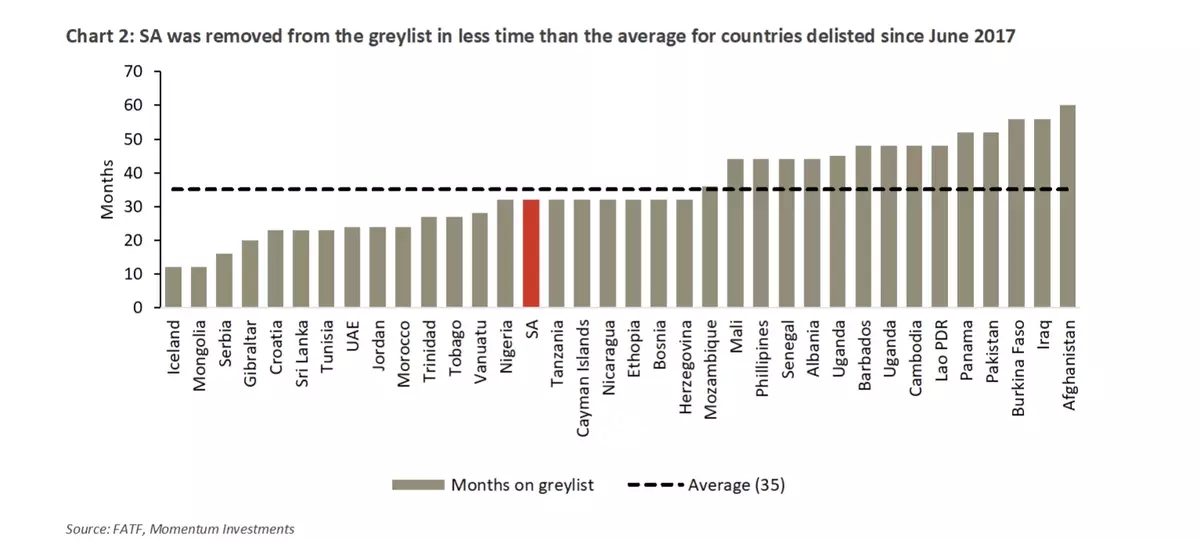
As widely anticipated, the Financial Action Task Force (FATF) announced on 24 October 2025 that South Africa (SA) has exited the greylist, marking the end of 32 months of enhanced monitoring and reflecting the country’s substantial progress in strengthening its anti-money-laundering and counter-terrorist-financing (AML/CFT) system, by addressing its technical shortcomings and showcasing improvement across areas of law enforcement and financial supervision.

Sanisha Packirisamy, Chief Economist, Momentum Investments and Tshiamo Masike, Economist, Momentum Investments explain the implications in more detail.


On 24 February 2023, SA was added to the greylist because of shortcomings in the effectiveness of AML/CFT and counter-proliferation measures as well as insufficient implementation of the technical requirements outlined in the FATF recommendations. The FATF set 22 action items, following a mutual evaluation report in 2021, to address technical compliance in SA’s legislative and regulatory frameworks, as well as to improve how effectively the laws were being enforced. By June 2025, SA had largely resolved all 22 identified deficiencies through cooperation with the country’s public and private sectors.
Regional peers also make the leap
There were other countries removed from the FATF greylist in October 2025. These included:
Burkina Faso (after 56 months): The country remained on the FATF greylist for more than four years due to deep-rooted institutional weaknesses, security instability and limited capacity to enforce AML reforms. Its eventual removal reflected tangible progress in supervision, enforcement and international cooperation, rather than mere legislative change.
Mozambique (after 36 months): Significant deficiencies in its AML/CFT regime, including weak supervision, enforcement capacity and non-profit/non-governmental organisation oversight put Mozambique on the greylist initially. It has since successfully implemented its 26-point reform plan, including improving supervision and law enforcement.
Nigeria (after 32 months): Nigeria was placed on the FATF greylist in February 2023 due to gaps in AML enforcement, beneficial-ownership transparency and inter-agency coordination. It successfully implemented its 19-point reform plan since then, including strengthening its institutions and undergoing legislative reforms.
At present, 20 countries remain on the greylist1.
Muted market reaction
Given that the mutual evaluation report had earlier flagged serious deficiencies in SA’s AML/CFT regime, when SA was formally added to the greylist, the move did not come as a surprise to markets. SA’s 10-year government bond yield and the currency were largely stable while the equity market weakened (see chart 3).
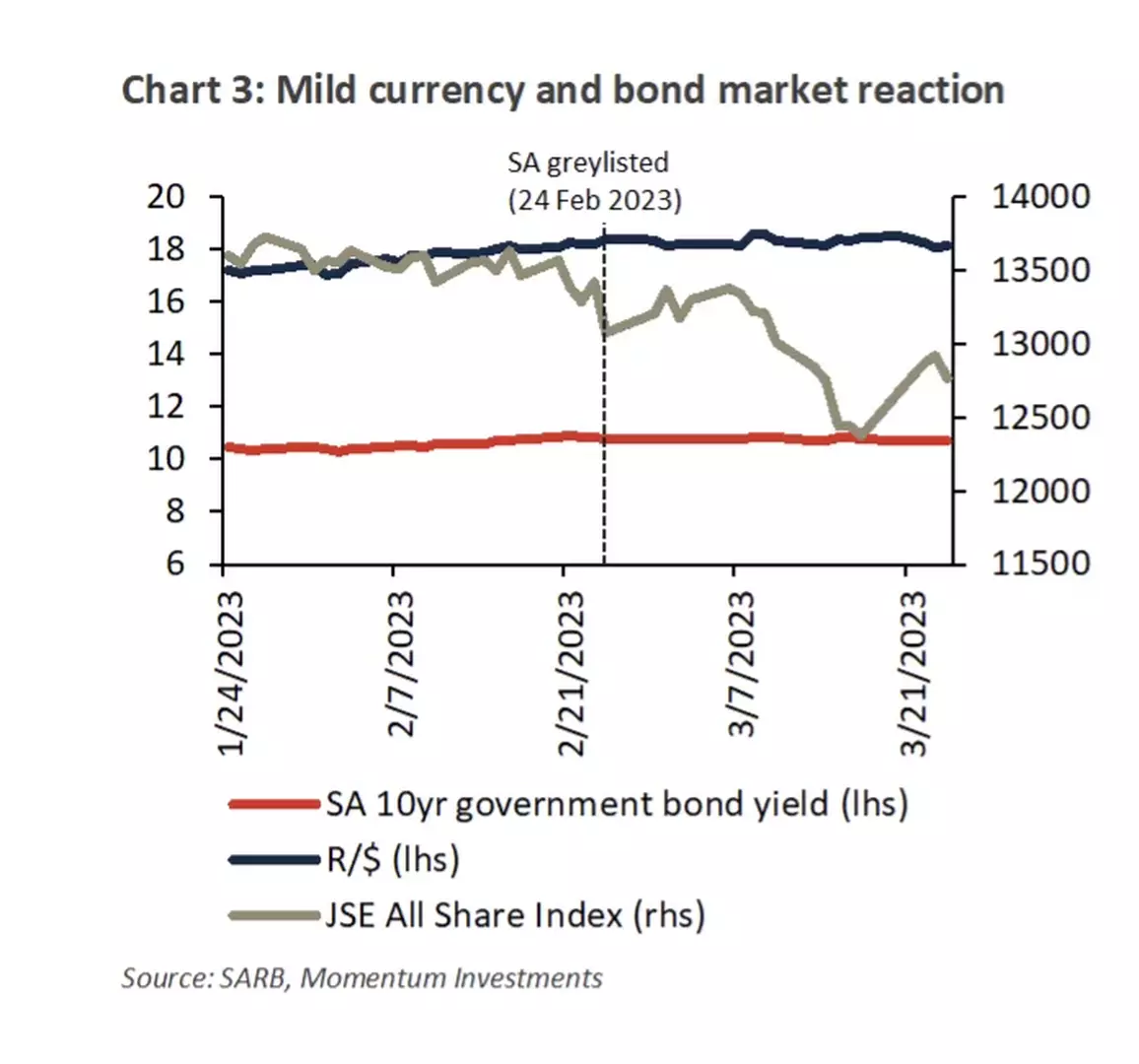
Similarly, at the point of removal, the favourable reaction in markets was modest, given that regulators and policymakers had signalled for months that the country had made substantial progress in addressing the 22 action items and analysts had largely priced in the likelihood of delisting. In the days leading up to the announcement, the rand firmed slightly in anticipation, but the official decision on 24 October 2025 prompted only a muted response across financial markets.
Restoring confidence
SA’s removal from the greylist is a validation of institutional reform. It is an endorsement that helps to lower long-term transaction costs, improve financial credibility and ease cross-border flows, even if it does not ignite an immediate growth surge.
The move alone is unlikely, however, to trigger an upgrade to SA’s sovereign credit ratings. Rating agencies will want to see sustained evidence of fiscal consolidation, through better revenue performance, disciplined spending and a stabilising debt trajectory, alongside a clear upward trend in reform-driven growth. Only when structural reforms begin translating into stronger, more predictable growth will the improvement in governance and institutional quality filter meaningfully into SA’s sovereign risk profile.
Back in the clear (for now)
The journey does not end here. FATF indicated that ‘SA should continue to work with the FATF and the Eastern and Southern Africa Anti-Money Laundering Group to sustain its improvements in its AML/CFT system’. The next FATF mutual evaluation is scheduled for April 2027 and SA will need to maintain reform momentum and demonstrate ongoing political commitment to avoid a relapse, as seen in cases like Uganda and Lao PDR. Nonetheless, the country’s exit from the greylist shows what coordinated reform and institutional commitment can achieve. We believe this is a key step in restoring confidence and making SA a more attractive and accessible destination.
1 Algeria, Angola, Bolivia, Bulgaria, Cameroon, Côte d’Ivoire, Democratic Republic of the Congo, Haiti, Kenya, Lao People’s Democratic Republic (PDR), Lebanon, Monaco, Namibia, Nepal, South Sudan, Syria, Venezuela, Vietnam, Virgin Islands (UK), Yemen
Subscribe to our free newsletter
Stay at the forefront of financial advisory excellence with MoneyMarketing's weekly insights. As a professional adviser, you'll receive carefully curated content that enhances your practice and client relationships without cluttering your inbox. Our commitment to delivering only relevant, actionable intelligence helps you make informed decisions that drive your business forward. Join our community of leading financial professionals today and transform your practice with our complimentary newsletter—because your success is our priority.